
Views: 0 Author: Site Editor Publish Time: 2026-07-08 Origin: Site


Wet Flue Gas Desulfurization (FGD) systems present one of the most hostile environments in industrial power generation. They combine extremely low pH levels, high continuous temperatures, and severe chloride concentrations. Premature piping failure causes unscheduled, expensive plant outages. It also leads directly to non-compliance with strict environmental emissions standards and massive replacement operations. Standard piping materials degrade rapidly under these harsh conditions. They suffer heavily from localized pitting, deep crevice corrosion, and dangerous chloride stress corrosion cracking (CSCC). Specifying the correct stainless steel seamless pipe for flue gas desulfurization directly prevents these catastrophic failures. You must match the material metallurgy precisely to specific zone conditions like absorber towers and slurry lines. This careful selection eliminates hidden structural vulnerabilities entirely. This guide provides a detailed technical framework. We help you evaluate, shortlist, and procure the right corrosion-resistant alloys for your critical FGD applications.
Weld vulnerabilities are eliminated: Seamless pipes remove the heat-affected zone (HAZ), a primary initiation site for pitting in FGD scrubber environments.
PREN drives grade selection: Pitting Resistance Equivalent Number dictates material viability; environments exceeding 10,000 ppm chlorides require high-alloy solutions like 904L seamless pipe or super austenitic grades.
Wet FGD systems create brutally aggressive operational realities for any metallic structure. As sulfur dioxide reacts with water, continuous sulfuric and sulfurous acid condensation occurs along the pipe walls. Simultaneously, the system pumps limestone slurry to neutralize these acids. This slurry introduces intense abrasive forces during fluid transport. Standard metals cannot survive this relentless chemical attack combined with continuous mechanical wear. The environment demands highly specialized metallurgical solutions to maintain operational integrity over time.
Recirculated slurry continually concentrates chlorides within the closed-loop system. Coal combustion releases trace halogens like chlorine and fluorine into the flue gas. The scrubbers wash these halogens directly into the circulating liquor. Because modern facilities reuse water extensively to meet environmental targets, chloride levels spike dangerously. Concentrations frequently jump from a baseline of a few hundred parts per million to well over 10,000 ppm. This drastic accumulation significantly lowers the threshold for localized corrosion. It actively breaks down the protective passive oxide layer on standard steel grades.
You must understand three primary failure modes to specify the correct alloy:
Pitting and Crevice Corrosion: Extremely low pH and high chloride levels drive this aggressive attack. Calcium sulfate scale deposits form tight crevices along the pipe interior. Aggressive chloride ions concentrate underneath these deposits, creating localized acidic micro-environments that eat through the pipe wall.
Chloride Stress Corrosion Cracking (CSCC): High operating temperatures trigger this sudden and catastrophic failure mode. Tensile stress from internal fluid pressure interacts dangerously with halide ions. This causes microscopic cracks to propagate rapidly through the metal grains.
Erosion-Corrosion: Slurry delivery lines face severe synergistic threats. The moving limestone mechanically strips away the protective chromium oxide layer. Chemical acids immediately attack the freshly exposed, vulnerable metal. This cycle accelerates material loss exponentially.
Seamless manufacturing guarantees a homogeneous microstructural grain across the entire pipe body. Manufacturers pierce a solid steel billet at extreme temperatures to create the hollow tube. Welded pipes inherently contain a longitudinal weld seam and an adjacent heat-affected zone (HAZ). During welding, chromium carbides often precipitate along grain boundaries, depleting the surrounding matrix of essential chromium. These welded areas act as vulnerable anodic regions. They remain highly susceptible to preferential galvanic attack when exposed to acidic slurry fluids.
Seamless pipes offer superior pressure ratings and predictable fluid dynamics. They maintain a highly consistent internal surface roughness throughout their entire length. Welded pipes frequently feature minor internal weld roots or bead protrusions. These tiny obstacles create localized fluid turbulence. They also act as physical snag points where abrasive limestone slurry particles accumulate. This smooth interior of a seamless pipe significantly reduces the likelihood of slurry scaling. You avoid dangerous under-deposit corrosion when solid scale cannot adhere tightly to the pipe walls.
You must implement seamless formats in your most critical process zones. They remain absolutely non-negotiable for high-pressure slurry delivery lines. Spray headers and precise chemical injection points also demand uninterrupted structural integrity. We strongly recommend seamless designs to eliminate unexpected pipeline ruptures and expensive emergency repairs. Every single weld represents a potential microstructural failure point in an FGD environment. Seamless pipes systematically and permanently remove this risk from your facility.
Engineers must match the specific alloy composition to the exact chemical zone. Using the wrong metallurgical grade guarantees early failure and severe process leaks. Here is a comprehensive material evaluation checklist to guide your selection.
Standard austenitic grades like 316 and 316L serve only the mildest, low-chloride environments. You can specify them safely for low-temperature ancillary systems or clean make-up water lines. They carry a massive risk of catastrophic failure inside the main absorber loop. We strongly advise against using them anywhere acid concentrations fluctuate or where chloride levels exceed 1,000 ppm.
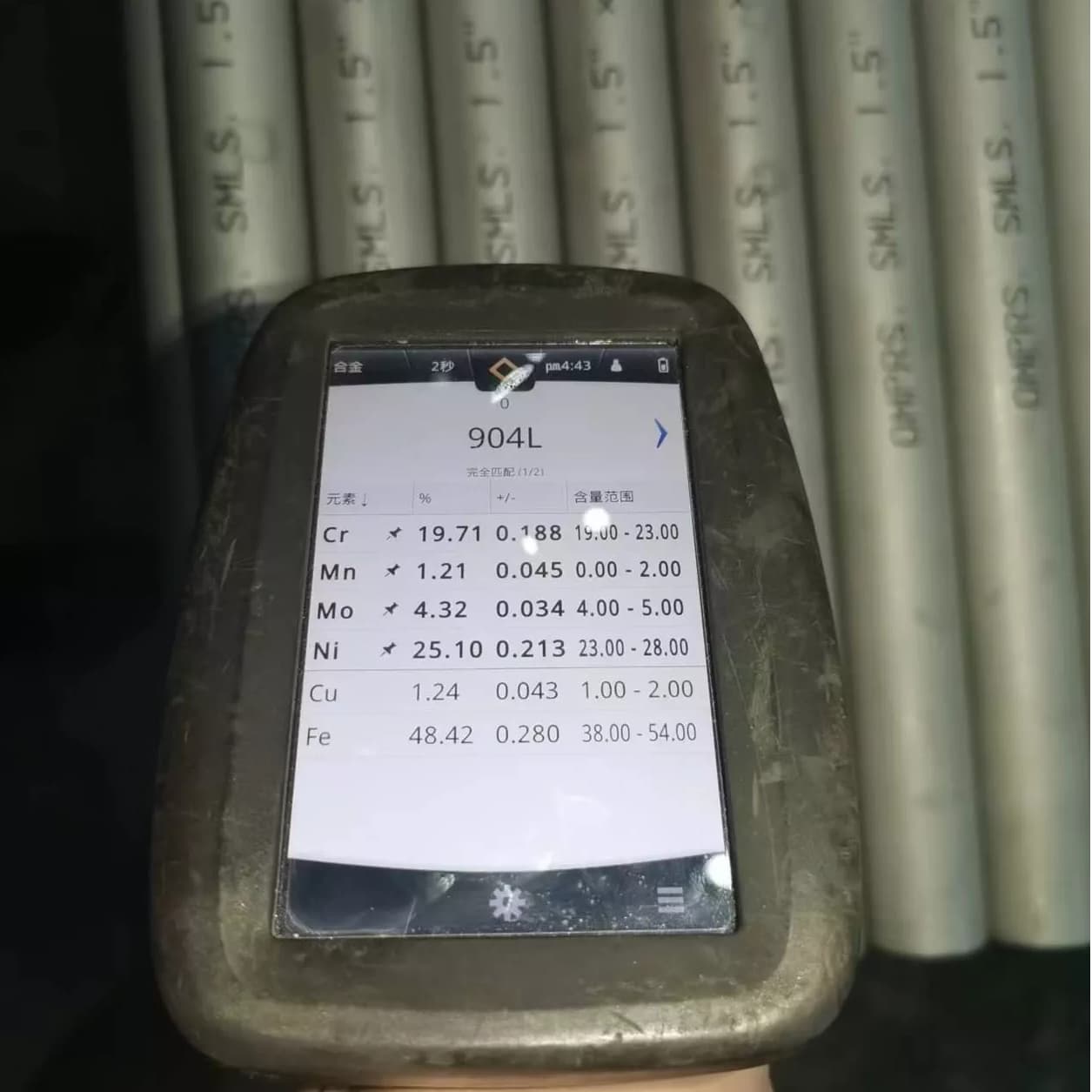
This grade provides an exceptionally high nickel (23~28%) and molybdenum (4%~5%) content. It delivers robust, predictable resistance against moderate-to-high chloride levels. The specific addition of copper allows a 904L seamless pipe to withstand concentrated sulfuric acid environments perfectly. Many power facilities consider this the most practical balance for standard wet FGD slurry piping. It effectively bridges the performance gap between standard commercial alloys and highly expensive exotic metals.
These robust alloys feature a Pitting Resistance Equivalent Number (PREN) above 40. You strictly require them for the most extreme chloride environments within the scrubber system. Zones exceeding 10,000 ppm chlorides and operating at very low pH levels demand this superior level of protection. They offer corrosion performance remarkably close to pure nickel-based alloys but at a notably more accessible price point.
We evaluate duplex grades for zones demanding massive mechanical strength. Their mixed austenite and ferrite microstructure handles intense physical erosion from thick, high-velocity slurries beautifully. However, you must carefully monitor their specific operational temperature limits. Continuous high heat exposure can cause dangerous alpha-prime embrittlement in duplex microstructures, leading to sudden mechanical failure.
Material Grade | Approximate PREN | Primary FGD Application | Key Limitation |
|---|---|---|---|
316 / 316L | 23 - 28 | Ancillary water systems, low chloride zones | Highly susceptible to pitting > 1,000 ppm chlorides |
904L | 34 - 36 | Main absorber loop, moderate slurry lines | Struggles in ultra-high chloride environments |
254SMO (Super Austenitic) | 42 - 45 | Extreme high-chloride zones, low pH headers | Requires specialized welding procedures if modified |
2507 (Super Duplex) | 42 - 43 | High erosion slurry transport, agitators | Strict maximum operational temperature limits |
Modern procurement decisions require rigorous technical justification. You must apply standard metallurgical formulas and regulatory frameworks to ensure long-term reliability.
Procurement engineers must utilize the PREN formula to systematically benchmark any FGD stainless steel pipe. The globally accepted standard equation is (%Cr + 3.3x%Mo + 16x%N). This mathematical calculation benchmarks your chosen material directly against the projected facility chemistry. A higher calculated PREN confirms significantly stronger resistance to localized pitting and crevice corrosion. You must accurately match the selected PREN to your continuous chloride monitoring data to avoid over-engineering or under-specifying the pipeline.
Your metallurgical choices must align strictly with published EPRI (Electric Power Research Institute) guidelines. You should also deeply consult local environmental regulatory standards governing chemical containment. Facilities operating under strict governmental jurisdictions face intense structural scrutiny. Material compliance ensures absolute structural safety and environmental protection. It actively prevents disastrous chemical leaks that result from weakened, non-compliant piping joints.
Procurement strategies must move far beyond the initial, simple price-per-ton metric. You need to thoroughly factor in the expected uninterrupted service life of the chosen alloy. Evaluate the specific installation efficiencies for different material grades, as seamless pipes often require fewer maintenance checks. Look closely at downtime avoidance. High-performance alloys actively prevent expensive emergency scrubber shutdowns. Upgrading your initial material specification typically yields incredible long-term operational stability and drastically fewer replacement cycles.
Procuring specialized high-alloy materials carries distinct supply chain risks. You must enforce strict quality control measures long before physical installation begins.
Counterfeit or incorrectly alloyed materials pose a severe, silent threat to your facility. Substandard metals will disintegrate rapidly in aggressive FGD environments. We strongly emphasize the absolute necessity of Positive Material Identification (PMI). You must perform this verification on every single incoming pipe batch prior to installation. Modern handheld X-ray fluorescence (XRF) analyzers immediately detect incorrect chemical compositions. This prevents disastrous material mix-ups.
When sourcing your corrosion resistant pipe, you should always mandate strict EN 10204 3.1 or 3.2 Material Test Certificates (MTCs). These formal, legally binding documents guarantee the exact chemical composition of the heat lot. They also verify crucial mechanical properties like tensile strength, yield strength, and elongation. Never accept uncertified or vaguely documented shipments for critical scrubber applications. End-to-end traceability ensures absolute engineering confidence in your entire piping network.
Procurement teams must carefully factor in realistic manufacturing lead times. Specialized seamless drawing processes for exotic metals require extensive, complex production schedules. High-nickel alloys frequently face extended global supply delays due to raw material shortages. You must align your material procurement timeline perfectly with your planned plant outage. Ordering months in advance guarantees your critical materials arrive safely before the maintenance window actually opens.
Selecting the optimal stainless steel seamless pipe for flue gas desulfurization represents a delicate engineering compromise. You must balance maximum localized corrosion resistance against your realistic project procurement budget. The calculated PREN value remains your most reliable, objective guiding metric for this decision.
Your shortlisting logic should remain uncompromising. Eliminate all welded pipes for your high-pressure and high-chloride circulation zones. Default immediately to 904L or super austenitic seamless grades based entirely on your continuous chloride monitoring data.
Your next action requires direct professional consultation. Engage immediately with a specialized metallurgical supplier. Have them audit your current FGD fluid chemistry and operational temperatures accurately. Request detailed technical submittals and certified MTC samples for your required pipe schedules today.
A: The required PREN depends entirely on specific zone environments. Generally, you need a PREN greater than 35 for moderate scrubber zones. For highly aggressive absorber internals facing severe chloride concentrations, you must specify a PREN above 40. Always monitor your continuous chloride levels to benchmark this requirement accurately.
A: Grade 904L contains significantly higher levels of molybdenum, nickel, and copper compared to standard 316L. This specific chemical formulation drastically improves its resistance to concentrated sulfuric acid. It also provides a much higher threshold against dangerous chloride pitting, ensuring a much longer service life in aggressive slurries.
A: Seamless pipes completely eliminate the longitudinal weld seam and its associated heat-affected zone. This removes the primary microstructural failure point for under-deposit corrosion. The smooth, uninterrupted internal surface prevents abrasive limestone slurry from snagging and eroding weak joints. This structural integrity substantially extends the mean time between failures (MTBF).
A: Super duplex grades offer vastly superior mechanical strength and excellent erosion resistance for heavy slurry applications. However, they possess strict upper-temperature limitations compared to super austenitics. Exposing duplex alloys to excessive heat causes dangerous microstructural embrittlement. You must evaluate the exact operating temperatures before finalizing this material substitution.