
Views: 0 Author: Site Editor Publish Time: 2026-07-02 Origin: Site


Designing a reliable seawater reverse osmosis (SWRO) or thermal desalination plant presents a severe engineering challenge. You must balance highly corrosive chloride environments against long-term material lifecycle survival. Unfortunately, piping failures account for a massive percentage of unplanned plant downtime today. Pitting, crevice corrosion, and chloride stress corrosion cracking (SCC) rapidly destroy inadequate alloys in high-pressure lines. When critical manifolds fail, facilities face immediate, catastrophic operational halts and severe maintenance burdens. Right-sizing your material selection is not just an option; it is an engineering necessity. We will explore how to evaluate everything from standard austenitics to super duplex and nickel alloys based on precise operational parameters. You will learn to navigate key pitting resistance metrics, fabrication risks, and procurement standards. Ultimately, you will discover how to align mechanical properties with severe chemical demands to ensure continuous, reliable fresh water production.
Standard 316L stainless steel is generally insufficient for high-pressure seawater applications due to rapid localized corrosion risks; higher-alloyed materials are mandatory.
Duplex stainless steel pipe offers an optimal balance of high mechanical strength and chloride resistance, making it the industry standard for SWRO high-pressure lines.
Pitting Resistance Equivalent Number (PREN) dictates material suitability: environments with elevated temperatures or stagnant seawater demand a PREN > 40.
The choice between welded and seamless pipes impacts both structural integrity in high-pressure systems and localized corrosion risks at the heat-affected zone (HAZ).
Material selection directly dictates a desalination plant's operational viability. Over-specifying materials inflates initial capital expenditures unnecessarily. Conversely, under-specifying leads to catastrophic operational expenditures. These unseen costs include severe leaks, sudden downtime, and premature network replacement. You need the exact right grade for each specific operational zone.
We classify the primary corrosion mechanisms into three severe threats:
Pitting Corrosion: This causes a localized breakdown of the passive protective layer. It happens due to high chloride ion concentrations penetrating microscopic surface flaws.
Crevice Corrosion: Accelerated chemical attacks occur in tight spaces. Flanges, threaded joints, and areas under biofouling deposits trap stagnant water. These stagnant zones become highly acidic and rapidly dissolve the metal.
Chloride Stress Corrosion Cracking (SCC): High temperatures combined with tensile stress trigger microscopic cracks. This remains a severe risk in thermal desalination setups. Multi-effect distillation (MED) and multi-stage flash (MSF) systems frequently experience this failure mode.
You must practice strict system zoning. Differentiate low-pressure intake or outfall lines from high-pressure reverse osmosis pump manifolds. Lower-alloy grades often suffice for raw, low-pressure intakes. However, high-alloy materials remain absolutely non-negotiable for highly pressurized, wetted RO manifolds.
Standard austenitic grades like 304 or 316 fall short in raw seawater. They lack sufficient molybdenum and chromium. They belong strictly in non-wetted zones or highly diluted permeate lines. They degrade rapidly under direct, high-chloride exposure.
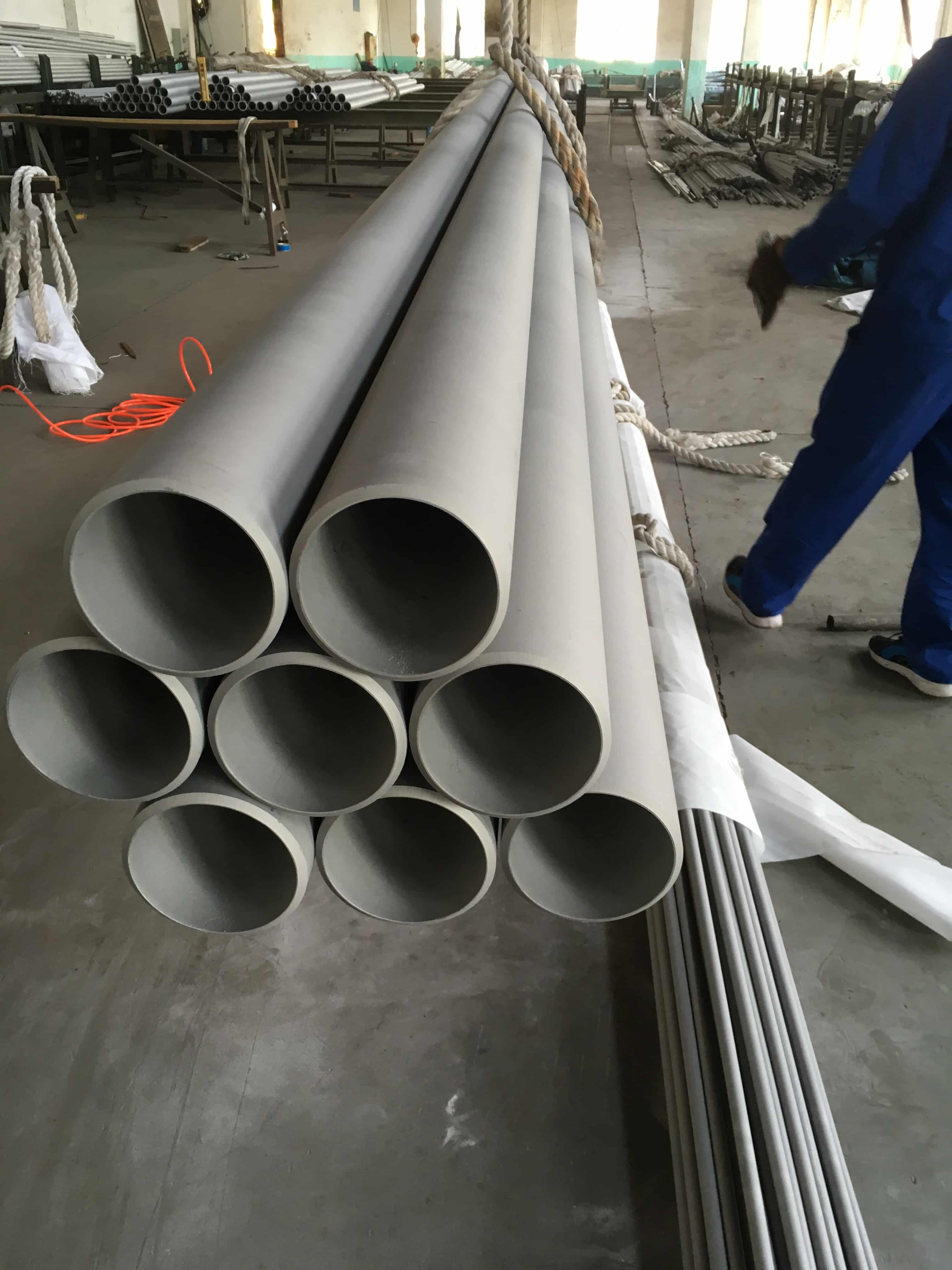
These grades feature a balanced mixed austenitic-ferritic microstructure. Common examples include alloy 2205 and alloy 2507. Duplex stainless steel pipe remains the dominant, industry-standard choice for SWRO high-pressure piping. It offers roughly double the yield strength of standard austenitic grades. This superior strength allows engineers to design thinner pipe walls. It significantly reduces overall system weight and footprint.
The trade-off lies in fabrication complexity. Fabrication requires strict welding controls. You must maintain the delicate 50/50 phase balance. Improper heat treatment easily triggers deleterious phase formations. This leads directly to severe structural embrittlement.
We classify these as top-tier, high-performance alloys. Notable examples include Inconel, Hastelloy, and Monel. You should reserve nickel alloy pipe for the absolute most extreme environments. High-temperature thermal desalination evaporation stages demand them. Zero liquid discharge (ZLD) systems also rely heavily on them. Plant areas processing highly concentrated brine or aggressive acidic cleaning chemicals require this ultimate durability.
The primary trade-off is the maximum initial capital expenditure. You only specify them when super duplex or super austenitic grades fail the lifecycle cost-benefit analysis. They are problem-solvers for the harshest possible niches.
The Pitting Resistance Equivalent Number (PREN) acts as your primary baseline screening tool. The formula evaluates theoretical pitting resistance. The calculation is straightforward: %Cr + 3.3 × %Mo + 16 × %N. Higher numbers indicate stronger resistance against localized chloride attacks.
We rely on established threshold benchmarks to guide preliminary material shortlisting.
Alloy Category | Typical PREN | Seawater Suitability Benchmark |
|---|---|---|
Standard 316L | 23 - 28 | Risky for direct, high-pressure raw seawater. Use for permeate. |
Super Austenitic (904L) | 34 - 36 | Suitable for moderate chloride and warm seawater. |
Standard Duplex (2205) | 35 - 38 | Excellent for standard SWRO high-pressure manifolds. |
Super Duplex (2507) | 40 - 43 | Recommended for continuous exposure to high chlorides and elevated heat. |
However, you must look beyond PREN. PREN remains a strictly theoretical calculation. Real-world evaluation must also include empirical temperature metrics. The Critical Pitting Temperature (CPT) and Critical Crevice Temperature (CCT) are vital. A high PREN means nothing if operational fluid temperatures exceed the alloy's specific CPT. You must align the PREN with regional climate data.
Even the highest-grade alloy fails if fabrication practices fall short. You must rigorously manage structural integrity and surface chemistry during plant construction.
Seamless versus welded construction dictates different risk profiles. You should carefully evaluate stainless steel pipe for seawater desalination configurations. Seamless designs eliminate heat-affected zone (HAZ) vulnerabilities entirely. They offer superior structural integrity for high-pressure pump manifolds. If your design utilizes welded pipe, you must mandate 100% radiography. You also require strict post-weld solution annealing. This thermal treatment dissolves harmful precipitates and restores baseline corrosion resistance.
Surface finish matters immensely in raw seawater lines. Rough internal surfaces actively accelerate dangerous biofouling. Micro-crevices trap stagnant chlorides and trigger localized corrosion rapidly. You must specify appropriate pickling and passivation standards. Frameworks like ASTM A380 provide reliable methodologies to ensure smooth, passive surfaces.
Galvanic compatibility represents a frequent, critical oversight. Never mix dissimilar metals in your piping network carelessly. Lack of proper dielectric isolation accelerates galvanic corrosion immediately. The less noble metal always deteriorates first. You must apply dielectric flange kits to break unwanted electrical circuits.
Allowing excessive heat input during duplex welding, which destroys the phase balance.
Failing to purge the inner pipe with inert argon gas, leading to severe oxidation or "sugaring."
Skipping mandatory chemical passivation after mechanical grinding or cutting.
Using carbon steel wire brushes on high-alloy surfaces, embedding reactive iron particles.
Procurement demands rigorous verification and uncompromising documentation standards. You cannot rely on baseline marketing claims when handling pressurized chlorides.
First, verify strict compliance and certification. Ensure your chosen material meets current international standards. ASTM A790 and A928 govern duplex and super duplex grades rigorously. ASTM A312 covers standard and super austenitic options. These standards dictate precise chemical compositions and mechanical testing methodologies.
Second, implement aggressive supplier vetting. Demand comprehensive Mill Test Certificates (MTC). You should look specifically for EN 10204 Type 3.1 or 3.2 documentation. Ensure the supplier proves total heat traceability. They must enforce strict QA/QC measures for phase-balance verification in all duplex materials. Third-party metallurgical audits add an extra layer of trust.
Finally, take actionable next steps. We advise engineers to compile a highly detailed material take-off (MTO) document. This MTO must go beyond mere dimensional sizing.
Specify the maximum operating fluid temperature.
Document the exact chloride concentration in parts-per-million (ppm).
Detail the peak operating pressure for RO manifolds.
Outline the expected frequency of acidic chemical cleaning cycles.
You use this comprehensive MTO to secure accurate technical quotes. Qualified manufacturers can then match your exact operational reality to the perfect alloy grade.
Successful desalination piping requires a pragmatic, informed balance. You must weigh the PREN, required mechanical strength, and strict manufacturing quality carefully. Selecting the wrong grade guarantees premature failure, while over-specifying wastes critical capital.
Duplex grades consistently offer the best return on investment for standard SWRO facilities. They provide exceptional strength and high chloride resistance. Conversely, super-austenitic alloys and specialized high-nickel options serve specific, extreme niche environments perfectly. They conquer high heat and severe acidity where standard alloys crumble.
Do not leave your plant's reliability to chance. Contact specialized technical sales engineers for a project-specific material consultation today. Request a detailed quote based on your exact schematic requirements and chemical parameters. Ensure your next infrastructure build survives the salt.
A: Standard 316L possesses lower chromium and molybdenum levels. This creates severe susceptibility to pitting and crevice corrosion. When environments exceed 1,000 ppm chlorides, the passive layer breaks down rapidly. This leads to unpredictable pipe failure in high-pressure wetted SWRO manifolds. It belongs strictly in non-wetted or purified permeate lines.
A: Both feature a mixed austenitic-ferritic structure. Standard duplex handles moderate chloride exposure effectively and offers great strength. Super duplex contains much higher chromium, molybdenum, and nitrogen levels. This higher alloying provides a PREN above 40. It easily withstands harsher, warmer seawater conditions without suffering localized pitting.
A: Elevated temperatures exponentially increase the rate of chloride-induced corrosion. Warm climates and thermal desalination stages drastically lower a material's resistance threshold. You must select alloys whose Critical Pitting Temperature (CPT) exceeds your maximum operating temperature. Failing to account for temperature spikes guarantees rapid, catastrophic material degradation.
A: Seamless pipe is structurally superior for extreme pressures. It eliminates heat-affected zone vulnerabilities and weld-seam corrosion risks entirely. However, high-quality welded pipe remains highly viable. When manufacturers apply strict post-weld solution annealing and 100% radiography, welded options become highly dependable and cost-effective for larger pipe diameters.