
Views: 0 Author: Site Editor Publish Time: 2026-04-20 Origin: Site


Procuring industrial piping presents a familiar but critical tension. You must constantly balance competing priorities. On one hand, seamless manufacturing requires higher upfront costs and extended lead times. On the other hand, welded alternatives carry structural limitations and demand intensive inspection protocols. This guide speaks directly to procurement directors, project managers, and piping engineers. You are the professionals making decision-stage evaluations for critical infrastructure across Oil & Gas, chemical processing, and structural engineering.
The stakes in this decision are immense. Selecting the wrong pipe type heavily impacts your Total Cost of Ownership (TCO). A misstep can lead to catastrophic system downtime. It can cause failed safety inspections. It often results in massively over-engineered budgets that drain project resources. In the following sections, you will discover how production methods dictate physical performance under severe stress. We will explore core evaluation criteria, examine lifecycle economics, and detail a hybrid procurement strategy to help you optimize both system safety and project spending.
Seamless pipe handles ~20% higher working pressures and is the gold standard for high-temperature, critical-fatigue environments (e.g., ASTM A106).
Welded pipe (ERW, LSAW, SSAW) offers superior wall thickness uniformity, better availability, and a 20–30% baseline cost reduction (e.g., ASTM A53).
Optimized procurement relies on a Line Criticality Matrix—deploying seamless for high-risk zones and welded for utility/low-pressure lines.
Mitigating supply chain risks requires strict validation of Mill Test Certificates (MTC) and Non-Destructive Testing (NDT) reports, regardless of the chosen pipe type.
Understanding the manufacturing process reveals why a seamless pipe behaves differently under mechanical stress. Production begins with a solid steel billet. Manufacturers heat this billet to extreme temperatures and pierce it through the center. From there, they shape the hollow shell using one of two primary methods: hot-rolling or cold-drawing.
Hot-rolling accommodates larger dimensions. It can produce diameters up to roughly 660mm. However, the extreme heat leaves a rougher surface finish and wider dimensional tolerances. Cold-drawing takes a different approach. Operators pull the metal through dies at room temperature. This delivers extreme precision. It allows for ultra-thin walls down to 0.5mm and handles very small diameters perfectly.
The Eccentricity Trade-off: You must acknowledge a realistic limitation. The piercing process rarely creates perfect concentricity. Because the billet is pierced while hot and malleable, slight wall thickness variations occur. Engineers call this "eccentricity." Welded pipes, which start as flat rolled plates, do not suffer from this specific variation.
Welded formats begin as flat steel coils or plates. Facilities roll these flat materials into cylinders and fuse the edges together. We categorize them by their specific welding technique.
ERW (Electric Resistance Welded): Facilities cold-form a steel strip into a tubular shape. They pass a high-frequency alternating current through the edges. This melts the steel together without any filler metal. ERW is ideal for low-to-medium pressure fluid transport.
LSAW (Longitudinal Submerged Arc-Welding): This method uses a U-O forming process. Heavy steel plates are pressed into a "U" shape, then an "O" shape. Machines apply double-sided welds (inside and out). LSAW delivers exceptional straightness and roundness. It supports large-diameter applications up to 60 inches. It often acts as a highly economical alternative to massive seamless lines.
SSAW (Spiral Submerged Arc-Welding): Manufacturers roll steel strips in a spiral matrix and weld the seams. This is incredibly efficient for ultra-long infrastructure and municipal water distribution. However, the extended length of the spiral weld makes it unsuitable for high-pressure industrial environments.
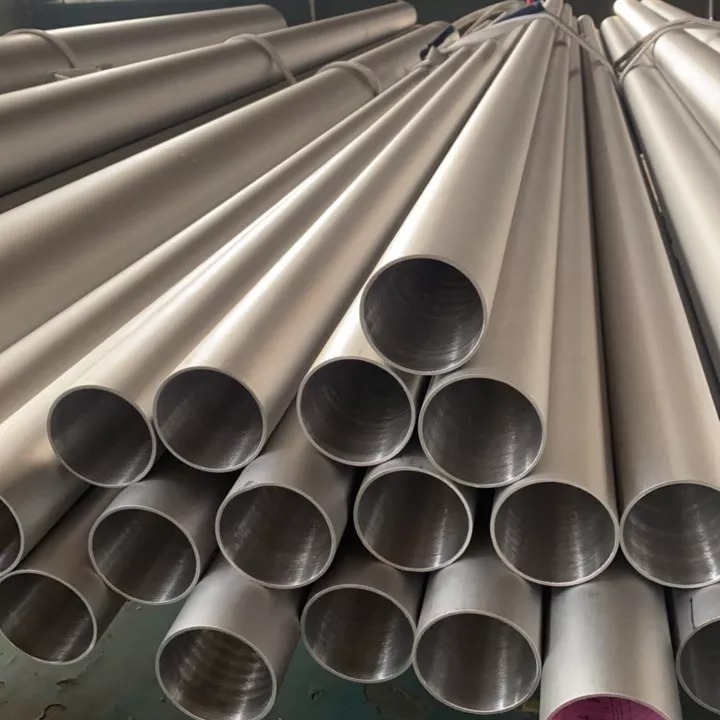
When you evaluate ASME stress ratings, the fundamental difference becomes obvious. Seamless formats lack a weld seam. In structural engineering, a weld seam represents the theoretical weakest link in any pressure vessel. Because seamless structures distribute physical stress evenly across a continuous grain structure, they achieve a naturally higher pressure threshold. They typically handle working pressures roughly 20% higher than their welded counterparts of the exact same material grade and wall thickness.
You must pay close attention to the Heat-Affected Zone (HAZ) in welded materials. The extreme thermal shock of the welding process alters the metal's internal microstructure. It changes the grain boundaries and can precipitate carbides. This microscopic transformation makes the seam highly susceptible to localized corrosion, galvanic attacks, and chloride-induced pitting.
This is exactly why specifying a Stainless steel seamless pipe is often a non-negotiable mandate for severe environments. If you operate offshore oil rigs, chemical processing plants, or handle highly acidic and chloride-heavy fluids, you cannot risk a HAZ failure. A continuous stainless matrix provides unified, uninterrupted defense against aggressive chemical attacks.
You must align your engineering ideals with market realities. Procuring seamless variants over 24 inches in diameter is exceedingly rare. The process requires massive, specialized extrusion machinery. It is highly energy-intensive and practically cost-prohibitive for long runs. Therefore, welded formats win by default in large-scale trunk lines. If you need a 48-inch distribution main, LSAW or SSAW is your only realistic choice.
Evaluation Metric | Seamless Process | Welded Process (ERW/LSAW) |
|---|---|---|
ASME Pressure Threshold | Maximum rating (No weld seam factor) | Derated (Requires weld joint efficiency factor) |
Wall Thickness Uniformity | Subject to slight eccentricity | Highly uniform (starts as flat plate) |
Corrosion Resistance | Uniform microstructure throughout | Vulnerable at the Heat-Affected Zone (HAZ) |
Maximum Diameter Limits | Typically tops out around 24 inches | Readily available up to 60+ inches |
Let us acknowledge the upfront baseline. Welded pipes are typically 20% to 30% cheaper to source than seamless options. They require significantly lower energy consumption during manufacturing. They also benefit from faster production cycles. Flat steel is cheaper to produce and roll than a solid steel billet is to pierce. If you manage a strict initial budget, this price gap looks highly attractive.
Smart procurement shifts the focus away from unit price. You must evaluate the Total Cost of Ownership (TCO) over a 20-year or 30-year operational lifecycle.
Seamless ROI: The higher initial investment quickly offsets itself in critical applications. Consider the impact of a single pipeline failure in a high-pressure refinery zone. Unplanned downtime costs thousands of dollars per minute. Environmental cleanup and safety fines scale exponentially. In these high-risk areas, the continuous structural integrity acts as an insurance policy. It easily eclipses the upfront material savings.
Welded Maintenance: You must factor in the hidden operational costs of welded systems. Industrial safety codes require mandatory, high-frequency Non-Destructive Testing (NDT) to monitor weld seam integrity over time. Conducting ultrasonic testing, radiographic X-rays, or eddy current testing requires expensive specialized labor. Over a decade, the cumulative cost of inspecting thousands of linear feet of weld seams will frequently surpass the initial 30% purchase savings.
Best Practice: Always run a 10-year TCO model. Include the labor costs for mandatory NDT inspections when presenting your budget to the executive board.
We strongly advise against blanket project specifications. Insisting on "100% seamless" wastes capital. Insisting on "100% welded" compromises safety. Instead, propose a dynamic matching model based on operational risk. Engineers call this a Line Criticality Matrix. You deploy your budget strategically, matching the manufacturing method directly to the fluid risk.
Reserve your premium materials for zones where failure equals catastrophe. These include high-temperature and high-pressure lines. Use them in fatigue-critical areas subject to heavy vibration. Boiler tubes, reactor feeds, and highly corrosive fluid handling systems demand continuous wall integrity.
Standard Alignment: For carbon steel, typically specify under ASTM A106. For stainless applications, strictly follow ASME B36.19 standards to guarantee performance under aggressive conditions.
Protect your project budget by deploying welded materials in low-risk zones. Long-distance fluid distribution, structural framing, and HVAC cooling water lines rarely encounter extreme stress. Low-pressure municipal grids and firewater loops are perfectly suited for seamed formats.
Standard Alignment: Typically specified under ASTM A53. For oil and gas gathering lines, use API 5L at the appropriate, lower Product Specification Level (PSL).
Global supply chains introduce high margins for error. You must provide a rigid framework to prevent costly miscommunications with overseas suppliers. A vague purchase order inevitably leads to rejected deliveries. You must define the following explicitly:
Material Grade: Specify the exact ASTM or API grade (e.g., A106 Gr. B).
Dimensions: State the Nominal Pipe Size (NPS) and the precise Schedule (wall thickness).
Lengths: Distinguish between Single Random Length (SRL, typically 16-24ft) and Double Random Length (DRL, typically 32-48ft). DRL reduces field welding time but requires larger shipping containers.
Align the end finish directly with your field installation method. Getting this right saves massive amounts of labor cost during construction.
Plain End (PE): Best for socket welding or slip-on flanges.
Beveled End (BE): Usually machined at a 30° angle. This is mandatory for standard butt-welding in the field.
Threaded End (TE): Used primarily for low-pressure gas or water lines.
Grooved End: Designed for Victaulic-style mechanical joints. These allow for rapid, weld-free assembly in HVAC or fire suppression systems.
Trust, but verify. You must demand rigid documentation before accepting any shipment. Require Mill Test Certificates (MTC) to validate the chemical composition and mechanical yield properties of the steel. Demand strict NDT documentation. For welded goods, require X-ray or ultrasonic reports to verify seam integrity. For continuous structures, demand tests verifying wall uniformity.
Common Mistake: Forgetting maritime shipping conditions. If you import materials across the ocean, the salt air will degrade bare steel rapidly. Always specify clear anti-corrosion coatings for transit, such as anti-rust oil, black varnish, or hot-dip galvanizing.
The final verdict hinges on your exact application. Seamless manufacturing serves as an essential insurance policy for extreme environments. It removes the weakest link and delivers unparalleled resistance to high pressures and corrosive attacks. Conversely, welded manufacturing remains the cornerstone of scalable, economical infrastructure. It offers supreme uniformity and cost efficiency for massive trunk lines and utility networks.
Your next step requires immediate action. Audit your system's operating pressures, temperatures, and fluid chemistry. We encourage buyers to consult directly with a metallurgical engineer to finalize a precise Line Criticality Matrix. By mapping out your high-risk and low-risk zones before issuing RFQs, you ensure maximum safety while fiercely protecting your project budget.
A: Not inherently; it depends on the application. For standard pressure water lines, welded is more cost-effective. For extreme chemical resistance, seamless is superior. It lacks a Heat-Affected Zone (HAZ), making it highly resistant to localized corrosion in aggressive environments.
A: A106 is exclusively seamless and designed for high-temperature and high-pressure service. A53 can be manufactured as either seamless or welded. Engineers primarily specify A53 for standard structural framing or low-pressure fluid applications.
A: No, the high-temperature piercing process can cause slight eccentricity, meaning the wall thickness varies marginally. Welded pipe starts from flat rolled steel plates, offering significantly more uniform wall thickness across the entire circumference.
A: Modern ERW and LSAW processes carefully minimize internal weld flash. However, in ultra-sensitive or high-velocity fluid systems, any slight internal protrusion can cause flow turbulence and pressure drops. In these highly calibrated scenarios, seamless formats remain preferable.