
Views: 183 Author: Site Editor Publish Time: 2025-12-02 Origin: Site


Surface Finish Requirements and Non-Destructive Testing Standards
Mechanical Performance and Pressure/Ambient Operating Conditions
Packaging, Delivery, Third-Party Inspection, and Logistics Parameters
Sourcing stainless steel welded pipe in high volume requires a level of technical clarity that goes beyond ordinary procurement processes. Buyers who need consistent large-scale supply—particularly for industries such as petrochemical, marine, energy, construction, HVAC, food equipment, or sanitary processing—must deliver detailed specifications to ensure stable production, predictable quality, and long-term repeatability. Without precise and complete technical data from the buyer, manufacturers cannot correctly produce or quote, and this often results in delays, mismatched materials, or pricing that misses the intended value level.
This guide focuses on what buyers must prepare and document before requesting quotations or placing production orders for stainless steel welded pipes in bulk. It provides the most critical data points, why they matter, and how technical alignment between buyer and manufacturer prevents downstream failures.
When sourcing stainless steel welded pipe in large quantities, the purchasing objective shifts from simple product acquisition to long-term specification control, quality consistency, and production repeatability. Volume sourcing impacts financial planning, delivery scheduling, tooling investment, long-term stock strategies, and even supplier qualification. Manufacturers need a detailed set of technical parameters to establish accurate unit cost, production feasibility, and capacity allocation.
At scale, stainless steel welded pipe production is not just about individual dimensions and grades; the supplier must understand production frequency (e.g., monthly, quarterly, spot ordering), forecast fluctuations, final application environments, and acceptable tolerance ranges. These elements help determine whether the supplier must invest in new molds, adjust welding lines, commit coil stock, adopt specialty certification, or implement additional inspection procedures.
The buyer’s intent can typically fall into one of several strategic categories:
| Buyer Objective | Supplier Production Implication |
|---|---|
| Lowest long-term cost | Larger minimum order quantities and coil reservation |
| Critical performance | Extra testing, stricter dimensional tolerances |
| Fast delivery | Higher buffer stock or scheduled rolling orders |
| Compliance-driven projects | Documentation, traceability, third-party audits |
Making these commercial priorities explicit allows the supplier to balance unit price, quality control, and delivery reliability, which is essential when buying stainless steel welded pipe in volume.
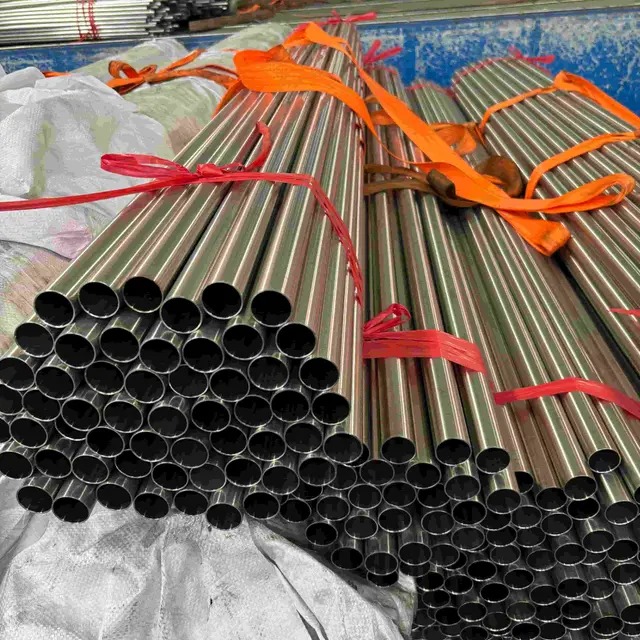
In high-volume sourcing, material specification is the foundation of the entire manufacturing process. Stainless steel welded pipe is available in multiple grades—such as 304, 304L, 316, 316L, 409, 321, 347, and duplex grades—and each offers different corrosion resistance, strength, and weldability characteristics. If the buyer fails to provide a precise grade, the supplier cannot confirm availability of hot rolled or cold rolled coil, raw material pricing, or suitability for the intended application.
In addition to grade designation, the buyer should provide chemical and performance standard references. For example:
| Specification Field Buyer Should Provide | Examples |
|---|---|
| Stainless steel grade | 304 / 316L / 2205 |
| Governing standard | ASTM, ASME, EN, DIN, JIS |
| Required surface condition of input coil | Mill edge, slit edge, cold-rolled annealed |
| Special alloy restrictions | Low carbon, Nb-stabilized, molybdenum enforced |
Manufacturers sourcing coil stock in high volume must often pre-reserve steel from mills. Without detailed grade definition from the buyer, the supplier’s cost planning and sourcing schedule will not be accurate.
Furthermore, large-scale buyers may require batch-to-batch stability or heat-number traceability. In such cases, the manufacturer must know whether certificates such as EN 10204 3.1 or 3.2 are required. Communicating these expectations at the RFQ stage prevents misalignment later and ensures the stainless steel welded pipe meets both regulatory and application-specific expectations.
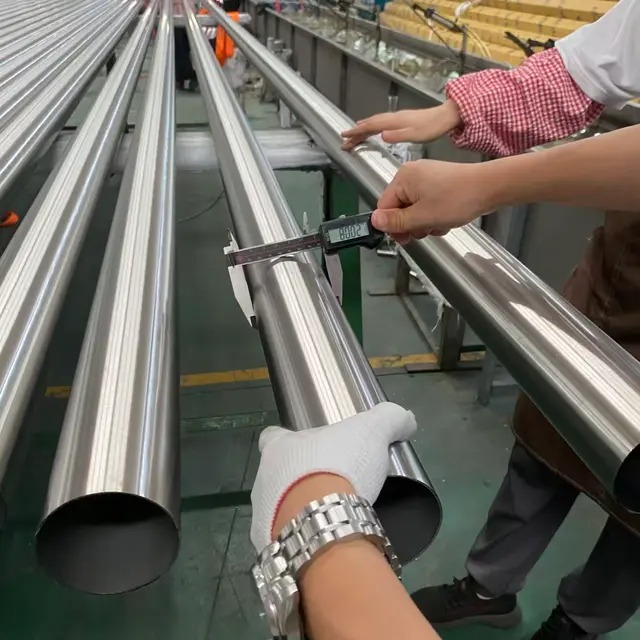
Dimensioning is one of the most critical portions of stainless steel welded pipe sourcing on a bulk scale. A manufacturer will need exact outer diameter (OD), wall thickness, length, ovality tolerance, straightness requirements, and end-type details before production scheduling or cost calculation can begin.
Dimensional precision affects not only final performance but production cost. For example, a buyer requesting OD tolerance of ±0.1 mm versus ±0.5 mm significantly changes tool selection, coil tolerance purchasing, and downstream grinding or sizing requirements. In long-run welded pipe production, tighter tolerance means slower production speeds, more tool changes, and additional inline inspection.
Common dimensional parameters a buyer must define include:
Nominal OD (e.g., 6 mm, 38 mm, 219 mm)
Wall thickness (e.g., 0.8 mm, 2.5 mm, 6 mm)
Length (cut-to-length or random length, e.g., 6 m standard)
Ovality limits
Straightness limits over total pipe length
ID restrictions where pipe must mate with couplings
In addition, buyers must specify whether their dimensional tolerances are governed by international standards such as ASTM A312, EN 10217, or GB/T standards, or whether they require bespoke tolerances unique to their assembly requirements.
For welded pipes used in high-precision applications such as heat exchangers or automotive system routing, dimensions often determine assembly fit, welding gap size, and bending alignment. Providing full dimensional details at the RFQ stage allows the supplier to match tooling and capacity and ensures stainless steel welded pipe arrives ready to use without costly downstream modification.
Surface finish is often underestimated by buyers but represents one of the major cost drivers in stainless steel welded pipe production. The finish influences corrosion resistance, weld seam visibility, food-contact sanitation, aesthetics, and internal fluid dynamics. Volume buyers must specify whether the pipe should be delivered in a mill finish, mechanically polished finish, 180-grit brushed finish, 400-grit sanitary finish, or any other condition.
In industries such as biopharmaceutical, dairy processing, and semiconductor fluid transport, internal surface roughness (e.g., Ra ≤ 0.4 μm) is not optional and must be confirmed before quoting. Manufacturers rely on these details to determine whether mechanical polishing, electro-polishing, passivation, or other post-processing will be required.
Alongside finish expectations, buyers in volume sourcing must communicate testing standards. Stainless steel welded pipe is commonly inspected using:
Eddy current testing
Hydrostatic pressure testing
Ultrasonic testing
X-ray weld seam inspection
If the buyer does not specify required test type and inspection sample rate, the manufacturer cannot quote accurately, because testing time and cost vary dramatically. For many export applications, test reports must also comply with specific standards such as:
EN ISO 9712
ASTM A999 / A1016
API inspection standards
Failure to define this early leads to inspection mismatches, shipment rejections, or costly re-rework. For volume sourcing, clarity on both finish and NDT requirements ensures performance consistency and correct production-line configuration.
Technical performance data determines how stainless steel welded pipe will behave under operating loads, temperature cycles, vibration, and service pressure. Manufacturers cannot select welding parameters, heat treatment requirements, or material selection unless they understand real-world application conditions.
Large-scale buyers must specify whether the pipe will be:
Pressurized or non-pressurized
Used for liquids, gas, or solid particulate transfer
Exposed to corrosive industrial chemicals
Operated in cryogenic or high-temperature environments
Subjected to mechanical vibration, bending, impulse cycles, or structural load
Performance data should include:
Maximum operating pressure (e.g., 1.5 MPa, 10 MPa)
Maximum internal temperature
External ambient temperature
Pressure test requirements (e.g., 100% hydrostatic test at 1.5× rated pressure)
Yield strength and tensile strength minimums
Hardness maximums for forming/bending
These parameters determine heat treatment needs—such as solution annealing—and influence the welding method selected. For example, pipes destined for high-pressure steam or corrosive environments may require full weld seam penetration combined with post-weld annealing to relieve internal stress.
If mechanical and thermal performance data is not provided, suppliers may under-specify, resulting in premature failure, or over-specify, adding unnecessary cost. In volume sourcing, this clarity allows suppliers to maintain consistent mechanical characteristics across every production batch.
Stainless steel welded pipe can be produced using TIG (GTAW), HF induction welding, laser welding, or plasma welding. Each method affects weld appearance, strength, productivity, and cost. Large-volume buyers should specify:
Welding method preferences
Acceptance standards for weld quality (e.g., internal bead removal, external bead appearance)
Seam finishing requirements
Whether the weld seam must be ground flush
Whether post-weld heat treatment is required
Whether tubing must be lint-free or fully pickled and passivated
In addition, traceability becomes increasing important for industrial pipelines, nuclear projects, medical fluid systems, and offshore applications. Buyers must specify how deeply suppliers need to document production identity, which may include:
Heat number trackability
Coil manufacturer information
Weld station logs
Operator identification
Inspection record traceability
Lot batching requirements
Without clarity on welding and documentation requirements, quoting becomes unreliable because these parameters dramatically influence cycle time, documentation effort, inspection cost, and production throughput. When sourcing stainless steel welded pipe in large volumes, these specifications help build a reproducible production system capable of delivering identical performance across months or years of supply.
Volume sourcing requires logistical planning and clearly defined delivery expectations. Stainless steel welded pipe is typically transported in bundles, crates, pallets, or protective films, but requirements vary based on finish sensitivity, corrosion risk, and export handling. Buyers must specify:
Packaging method (e.g., plastic sleeving, kraft-paper wrap, wooden crates)
Bundle quantity and maximum bundle weight
End protection such as plastic caps or shrink seals
Whether seaworthy export packaging is required
Whether packaging must prevent metal-to-metal abrasion
Logistics parameters may also include:
Delivery INCOTERMS (FOB, CIF, DDP)
Scheduled shipments (e.g., weekly, quarterly, blanket orders)
Warehouse drop-shipment routing
Labeling requirements for automated inbound scanning
Additionally, some industries require third-party inspection before shipment. Buyers should specify whether agencies such as SGS, TÜV, BV, or LR are required to witness testing, verify documentation, or sign inspection reports.
In large-volume sourcing, unclear packaging and logistics specifications commonly cause unexpected shipping cost increases, import approval failure, or damage in transit. Clear technical logistics documentation eliminates these risks and ensures stainless steel welded pipe arrives fully compliant and ready for immediate use.
Sourcing stainless steel welded pipe in significant production volumes demands a much higher degree of technical specification than one-time purchasing. Manufacturers must receive detailed material, dimensional, welding, testing, performance, and logistics information before providing accurate costing and production scheduling. When buyers define every parameter early—grade, finish, tolerances, mechanical stress environment, testing requirements, certification needs, and packaging expectations—the supply chain becomes stable, predictable, and efficient.
The best large-scale sourcing results come from treating the supplier not as a commodity vendor but as a technology partner. Clear technical data transforms production accuracy, reduces cost variation, shortens lead times, and keeps long-term projects operating without disruption. High-volume sourcing succeeds when specifications are complete and communicated early, enabling the supplier to deliver stainless steel welded pipe that performs consistently, shipment after shipment.
1. Why is detailed technical data required for volume sourcing of stainless steel welded pipe?
Because large-scale production requires coil reservation, tooling allocation, inspection planning, and long-term consistency. Without accurate specifications, cost and quality cannot be controlled.
2. What is the most important technical information suppliers need upfront?
Material grade, dimensional tolerances, surface finish requirements, welding standards, testing expectations, and operating conditions are the core data needed for precise quoting and production.
3. How does operating environment influence welded pipe manufacturing?
Temperature, pressure, corrosive media, and vibration determine the required heat treatment, material grade stability, weld penetration, and mechanical performance targets.
4. Can suppliers meet tight tolerances in volume manufacturing?
Yes, but buyers must define tolerances early because precision requirements influence production speed, inspection methods, tooling wear, and overall cost.
5. Are packaging requirements as critical as dimensional specifications?
Absolutely. Incorrect packaging often leads to surface scratches, corrosion during transport, or import handling problems—especially for polished, sanitary, or high-value stainless steel welded pipe.