
Views: 0 Author: Site Editor Publish Time: 2026-04-22 Origin: Site


For critical infrastructure, material failure is simply not an option. Whether you design high-pressure hydraulic systems or manage corrosive petrochemical pipelines, reliability matters deeply. The integrity of your piping system begins long before installation. It starts on the factory floor during the manufacturing phase. Unlike welded alternatives, a seamless pipe is engineered directly from a solid block of steel. This extrusion process eliminates the longitudinal seam entirely. It also removes heat-affected zones (HAZ) which often serve as dangerous points of vulnerability in extreme environments.
This guide details the exact manufacturing process behind these essential components. We cover the thermal treatments and stringent quality control protocols required to produce them reliably. By understanding these manufacturing stages, you gain the technical criteria needed to evaluate, specify, and source the right materials for your operational demands.
Seamless pipes are extruded and pierced from solid steel billets, ensuring uniform grain structure and superior burst-pressure capacity.
Production is segmented by outer diameter (OD) requirements, utilizing either Mandrel Mill (smaller OD) or Mannesmann Plug Mill (larger OD) processes.
Thermal finishing choices—Hot Rolled vs. Cold Drawn—directly impact dimensional tolerances, surface finish, and unit cost.
Rigorous Non-Destructive Testing (NDT), including ultrasonic and radiographic inspections, is non-negotiable for mitigating downstream operational risks.
To fully appreciate the value of this material, we must first look at the traditional alternatives. Welded pipes begin as flat steel sheets. Manufacturers roll these sheets into cylinders and weld the edges together. While this process is highly cost-effective, it inherently creates a structural weak point along the weld seam. The heat generated during welding also alters the local metallurgical structure. This creates a heat-affected zone prone to accelerated corrosion.
Seamless manufacturing avoids the welding process entirely. Extruding a solid billet ensures the metal grain flows continuously around the entire circumference. It eliminates the risk of weld-seam corrosion and mechanical weakness. This uniformity creates a superior product for demanding environments.
For engineering and procurement teams, this uniform circumference is a primary success criterion. It guarantees predictable behavior under stress. It makes this manufacturing method the default standard for high-temperature, high-pressure, and high-stress applications.
Furthermore, this production method offers immense material versatility. Factories apply this same extrusion methodology across a wide spectrum of grades. You can source standard carbon steel for general industrial use. Alternatively, you can specify high-alloy and Stainless steel seamless pipe for environments demanding extreme chemical resistance. The core structural benefits remain identical regardless of the base alloy.
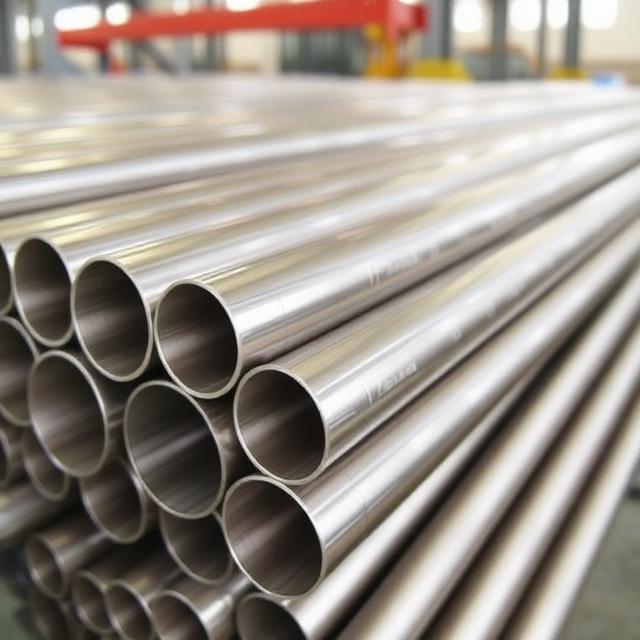
Creating a flawless metallic tube from a solid block of steel requires immense force and precise thermal control. Manufacturers follow a strict multi-phase cycle to guarantee structural integrity. Below is the standard step-by-step production cycle.
Phase 1: Billet Preparation and Heating. The process begins by sourcing high-grade solid steel billets. Quality control inspects these billets for surface defects. Once approved, the factory heats them in a rotary hearth furnace to extreme temperatures. They typically reach around 1,300°C (2,370°F). This achieves optimal malleability without melting or fracturing the steel. Common Mistake: Heating the billet too rapidly can cause thermal shock, creating internal fractures before piercing even begins.
Phase 2: Rotary Piercing. This is the most dramatic phase of the operation. Rollers grab the white-hot rotating billet and push it forward. A stationary piercing point aggressively drives through the center of the solid mass. The intense rotational pressure forces the steel to flow over the piercer. This action forms an initial, thick-walled hollow shell known as a bloom.
Phase 3: Elongation and Wall Reduction. The hollow shell is still too thick and irregular for industrial use. Operators roll the white-hot shell over a stationary mandrel or plug. Heavy rollers apply external pressure. This action stretches the pipe, reduces its wall thickness, and achieves precise concentricity. The metal grain aligns longitudinally during this stretching phase.
Phase 4: Sizing, Cooling, and Straightening. The elongated tube passes through a sizing mill. Multiple rolling stands carefully shape the metal to lock in the final outer diameter (OD). The hot pipe then moves to cooling beds. Controlled cooling rates prevent warping. Finally, a mechanical straightener corrects any slight bends introduced during the thermal cooldown.
No single machine can handle every pipe dimension. Manufacturers choose specific mill technologies based on the buyer's dimensional specifications. Scope dictates the solution. To manufacture smaller dimensions efficiently, factories use a continuous rolling method. For massive industrial pipelines, they deploy specialized heavy-duty equipment.
Mill Technology | Outer Diameter (OD) Range | Max Billet Weight | Primary Use Case |
|---|---|---|---|
Mandrel Mill | 1” to 6” | Lighter weights | Highly continuous production runs, precise small-diameter piping. |
Mannesmann Plug Mill | 6” to 16” (up to 24") | Up to 2 Tons | Heavy-duty industrial pipelines, thick-wall requirements. |
The Mandrel Mill process caters primarily to smaller diameters. After rotary piercing, the machinery pushes the hollow billet through a series of continuous rolling stands. A long, lubricated mandrel bar sits inside the hollow shell. The external rollers compress the steel against this internal bar. This mechanism reduces the wall thickness evenly while stretching the overall length.
This approach is ideal for highly continuous production runs. It provides excellent dimensional consistency. Industries relying on smaller fluid transport lines prefer this method due to its efficiency and speed.
Larger pipes require significantly more force and different tooling. The Mannesmann Plug Mill process handles massive steel billets weighing up to two tons. First, it utilizes a rotary elongator to expand the hollow shell. Then, the shell passes through a plug mill.
Instead of a continuous long bar, this mill uses a stationary plug attached to a rigid support. Rollers pass the massive shell over the plug repeatedly in a reciprocating motion. This smooths the internal surface and dials in the heavy wall thickness. This technique remains the industry standard for heavy-duty, large-diameter industrial pipelines used in oil, gas, and power generation.
The final processing temperature determines the material's ultimate mechanical properties. It also drastically impacts your procurement cost. Buyers must evaluate these features against their desired outcomes. Choosing the wrong thermal finish can lead to either premature failure or wasted budget.
Feature | Hot Rolled (Hot Finished) | Cold Drawn (Cold Finished) |
|---|---|---|
Processing Temp | Above recrystallization | Room temperature |
Surface Finish | Rougher, scaling present | Smooth, mirror-like finish |
Dimensional Tolerance | Slightly looser | Exceptionally tight |
Upfront Cost | Lower | Higher |
Hot finishing means operators complete the final sizing and shaping while the steel remains above its recrystallization temperature. The metal is highly pliable. This makes the shaping process fast and energy-efficient. However, cooling from extreme heat causes slight dimensional shifts. It also leaves a rougher, oxidized surface finish known as mill scale.
The Total Cost of Ownership (TCO) drivers here favor budget efficiency. Hot rolling offers lower initial manufacturing and procurement costs. These products are highly effective for general structural support and high-pressure fluid transport. If external aesthetics and microscopic tolerances do not matter, hot rolled is the pragmatic choice.
Cold drawing takes place at room temperature after the initial hot-rolling phase. Manufacturers clean the hot-rolled tube and pull it through precision dies. They also use an internal plug to size the inner diameter simultaneously. Drawing cold steel induces work hardening. This increases the yield strength but often requires subsequent heat treatments (like annealing) to restore flexibility.
The ROI drivers shift toward downstream savings. Cold drawing requires a higher upfront cost. Yet, it drastically reduces secondary machining costs. It provides a mirror-like finish and exceptionally tight dimensional tolerances. This is the critical process for manufacturing high-precision Stainless steel seamless pipe used in medical, aerospace, and advanced hydraulic applications where microscopic deviations trigger system failures.
A seamless manufacturing process is only as reliable as the testing framework validating it. Security and compliance framing is critical here. Before a factory certifies any component for industrial use, the product must pass stringent quality control gates. You cannot rely on visual inspections alone. Hidden internal defects can compromise an entire system.
Industry leaders implement comprehensive Non-Destructive Testing (NDT) protocols. These methods examine the internal structure without damaging the final product.
Ultrasonic Testing (UT): Technicians use high-frequency sound waves to scan the entire length of the tube. The waves bounce back when they hit inconsistencies. This detects internal wall thickness variations and hidden sub-surface defects accurately.
Magnetic Particle Inspection (MPI): Operators magnetize ferromagnetic materials and apply iron particles to the surface. The magnetic field leaks at the site of microscopic surface cracks, drawing the particles to the defect for easy visual identification.
Radiographic Testing (RT): For highly critical specification orders, factories deploy X-ray or gamma-ray evaluations. Radiography verifies internal consistency and captures imaging of the dense steel structure, ensuring zero porosity.
Beyond NDT, manufacturers perform rigorous Hydrostatic Testing. They seal the ends of the tube and pressurize it with water far beyond its normal operational capacity. This physical stress test confirms it can withstand working pressures without leakage or deformation.
Best Practice for Shortlisting: Never assume quality. Advise your procurement team to demand MTRs (Mill Test Reports). These reports trace the chemical composition and mechanical test results back to the original steel melt. Always verify specific API, ASTM, or ASME certifications when evaluating a new manufacturing partner.
The complex, multi-stage seamless manufacturing process yields the highest safety margins available for critical piping systems. By extruding solid steel billets, manufacturers eliminate longitudinal welds. This guarantees uniform pressure distribution and superior mechanical reliability. Selecting between hot-finished and cold-drawn variants allows you to balance dimensional precision against procurement budgets effectively.
Take time to audit your current piping specifications. Are you relying on welded products in high-stress environments? It might be time to upgrade. Contact your engineering or sales team today. Provide them with your specific OD, wall thickness, and material grade requirements to initiate an accurate TCO analysis or request an immediate RFQ.
A: The core difference lies in the starting material. We manufacture seamless products from solid steel billets. They are heated and pierced to form a hollow tube. Conversely, welded pipes start as flat steel plates. Factories roll these plates into cylinders and weld the edges together. Because it lacks a welded seam, seamless tubing offers superior pressure capacity and physical uniformity.
A: Yes, manufacturers can hot roll these stainless products. However, the exact material grade dictates the optimal finishing method. Standard industrial applications often accept hot finishing. If your project demands high corrosion resistance and tight dimensional tolerances, cold drawing becomes necessary. Cold finishing refines the grain structure and delivers the premium surface required for advanced applications.
A: Technological limits typically cap seamless production around 16 to 24 inches in outer diameter (OD). The Mannesmann plug mill process easily handles massive billets up to two tons. Expanding a solid billet beyond these dimensions becomes incredibly difficult and economically impractical. When projects require massive pipelines exceeding 24 inches, engineers typically specify heavy-wall welded pipes instead.
A: Cold drawing adds multiple complex steps to the manufacturing cycle. After hot rolling, the pipe cools to room temperature. Operators then pull it through hardened dies. This secondary operation requires specialized lubricants, costly tooling, and extensive time. It induces work hardening, forcing manufacturers to perform additional heat treatments to restore ductility. These extra processes significantly increase the final unit cost.